Table of contents
Airports are no longer the only places where travellers come home with a bottle in their bag, as a growing number of cities are turning spirits retail into something closer to a cultural stop than a simple purchase. From Tokyo to Edinburgh, immersive boutiques now promise tastings, storytelling, and local craft in a single visit, and they are benefiting from two converging trends: the rise of experience-led travel and the premiumisation of alcohol. The question is no longer what you drink, but where, how, and with whom you discover it.
From souvenir shelf to travel itinerary
Could a bottle really compete with a museum ticket? For an increasing share of travellers, it already does, because “souvenirs” have shifted from objects to moments, and premium spirits fit neatly into that logic: you can taste them, learn their origin, and take a piece of the story home. The wider market context helps explain why retailers are investing in this format, as the global spirits sector has leaned hard into higher-value products over the past decade; IWSR, one of the industry’s main data providers, has repeatedly documented how premium-and-above segments have grown faster than standard tiers across multiple categories, even when volumes softened in mature markets. In plain terms, fewer bottles can still mean more money, and that pushes brands and shops to create environments where a higher price feels justified, and where a visitor feels they bought more than liquid in glass.
At the same time, tourism has become more experience-intensive, and alcohol tourism has professionalised, moving beyond the classic distillery tour. Scotland’s whisky industry offers a clear benchmark: Scotch whisky exports reached £5.6 billion in 2022, according to the Scotch Whisky Association, before easing in 2023 amid global destocking and inflation pressures, a reminder that even iconic categories face cyclical demand. Yet visitor interest has proven resilient, and the whisky “experience economy” has expanded into city centres and transport hubs, where travellers may not have the time, or the willingness, to spend a full day in the countryside. Immersive boutiques are, in many ways, the urban answer to the distillery pilgrimage: shorter, curated, and designed for people who want to feel they encountered something local, even on a tight schedule.
That shift is also shaped by regulation and logistics, because alcohol is not an easy souvenir. Duty-free allowances vary, airline luggage rules push travellers towards smaller formats, and cross-border shipping can be expensive or restricted, depending on the destination. Immersive shops have started to respond with practical features: bottle personalisation, protective packaging, and staff trained to advise on what can be taken where. The retail pitch becomes a travel service, and when it works, the visitor leaves with both a product and a solution, which is precisely why these stores increasingly sit near tourist districts, major stations, and high-footfall streets.
Inside the rise of “drinkable” storytelling
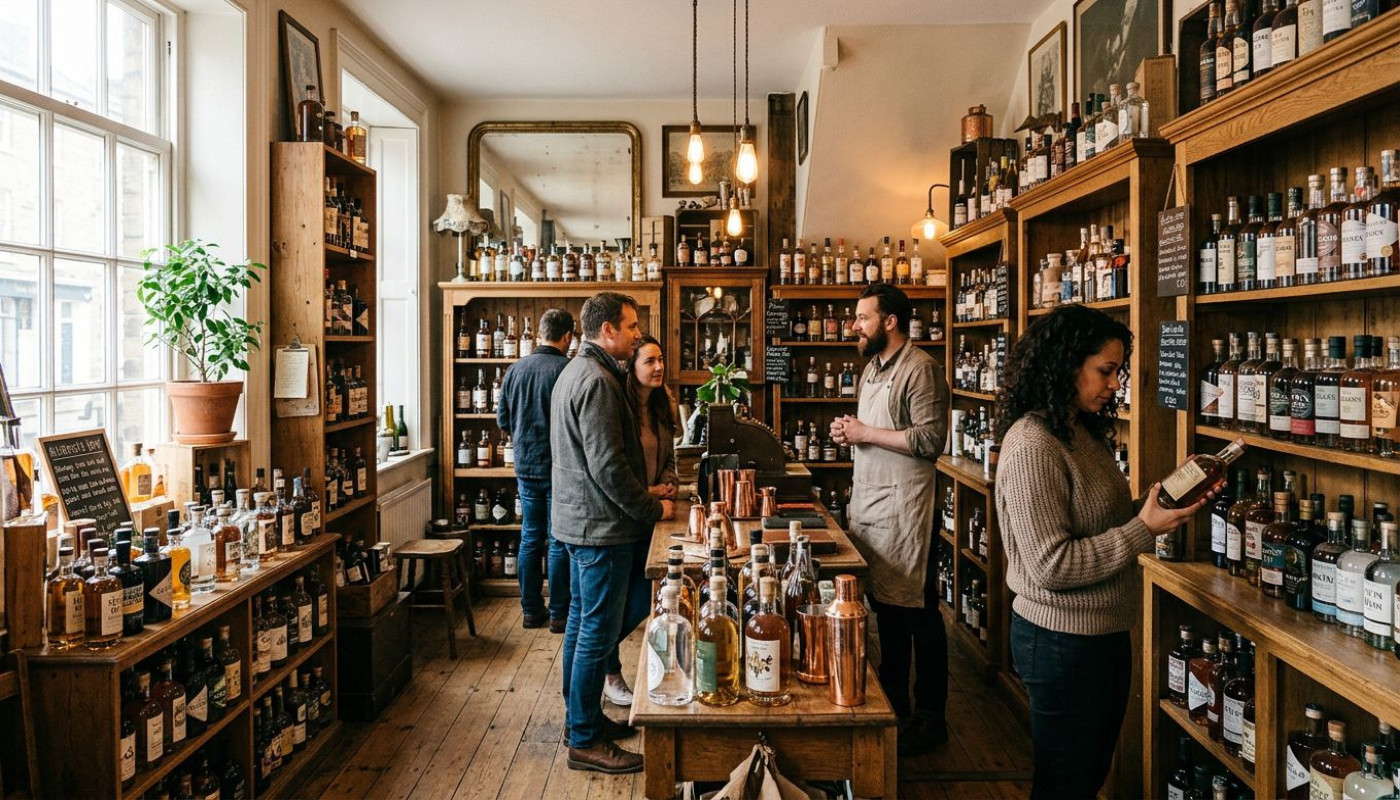
Why do these places feel closer to an exhibition than a shop? Because the commercial logic now runs through narrative, and spirits have a natural advantage: geography, production, and ageing lend themselves to storytelling in a way that few consumer goods can match. Immersive boutiques borrow from museums and hospitality, using guided flights, scent stations, ingredient displays, and staff-led explanations to translate production into something tangible. Done well, the customer does not simply browse; they participate, and that participation is what turns a discretionary purchase into a travel highlight.
This approach sits squarely in a broader shift in retail, where physical spaces try to offer what e-commerce cannot. Online, price comparison is immediate and brutal, and alcohol is often commoditised, especially at the mainstream end. In-store, however, the added value can be made visible: limited releases, local exclusives, and the credibility of an expert recommendation. There is data behind the business case, too. In travel retail, for example, the category is being rebuilt after the pandemic shock; IWSR has projected a return to, and potentially beyond, pre-2020 value levels over the medium term as international passenger numbers recover and shoppers continue to “trade up” when they do buy. Even where volumes remain under pressure, premiumisation gives retailers a reason to invest in higher-margin experiences rather than broader, cheaper ranges.
Immersive spirits boutiques also align with the way people now share travel. A tasting flight photographs well, a bottle with a local label reads as “authentic” on social platforms, and the act of discovery becomes content. That is not trivial: user-generated travel media influences where people go, what they buy, and how they describe a city’s identity. The risk, of course, is that experience becomes theatre without substance, and consumers have grown adept at spotting it. The shops that endure tend to be those rooted in genuine provenance, with staff who can answer hard questions about sourcing, maturation, and transparency, and with products that reward attention rather than merely packaging it.
Edinburgh’s spirits scene, concentrated and competitive
Edinburgh does not need to invent a spirits story, it only needs to concentrate one it already has. Scotland welcomed 3.2 million overseas visits in 2023, according to the Office for National Statistics’ International Passenger Survey estimates, and while Edinburgh is just one node in that flow, it captures a significant share through festivals, heritage tourism, and short-break travel. The city’s appeal is also practical: it is walkable, it is dense with landmarks, and it sits close to major transport connections, which creates the perfect conditions for compact, high-impact retail experiences. Travellers can slot a tasting between a castle visit and dinner, and still feel they engaged with a local craft tradition.
Competition is intense, and it pushes boutiques to differentiate. Whisky remains the headline act, but visitors increasingly look beyond it, and gin, rum, and liqueurs have all benefited from the premium trend and from a consumer appetite for flavour exploration. According to the SWA, Scotch exports are still heavily concentrated in major markets like the United States, France, and Singapore, and those markets also shape what tourists expect to find when they arrive in Scotland. Many have tried the big names at home, and they want something they cannot easily buy elsewhere, which is why limited editions, regional bottlings, and curated ranges have become central to the Edinburgh offer.
That is also where immersive boutiques can play a useful role for visitors who feel overwhelmed. Scotland’s whisky universe is famously complex, and even confident drinkers can struggle with styles, cask types, and regional identities, especially when confronted with hundreds of labels. A well-designed boutique reduces that cognitive load, and turns it into an enjoyable guided choice. For travellers planning a short stop, or for those who want a structured introduction before committing to a distillery day-trip, resources like https://www.edinburgh-spirit.com/ point to how the city’s spirits retail is being packaged as an experience in its own right, rather than an afterthought to sightseeing.
What travellers should watch: price, proof, and paperwork
A beautiful bottle is tempting, but is it a smart buy? The first thing to understand is that immersive retail often prices in the experience, and that can be fair, as long as the visitor recognises what they are paying for. A guided tasting with knowledgeable staff, a curated selection, and the chance to sample before buying all have a cost, and in expensive city-centre locations, overheads are real. The best protection is simple: ask what makes a bottle special, request the tasting notes, and compare with a baseline price on mainstream retailers if you have time. If a shop offers exclusives, ask whether they are truly exclusive to that venue, to the city, or simply to a distribution channel.
Next comes practicality, and it matters more than people admit at the moment of purchase. Alcohol limits differ by destination, and travellers should check their own country’s rules before buying multiple bottles. For example, the UK Government’s guidance for passengers travelling into Great Britain from abroad, and for those leaving the UK for the EU, sets out allowances and declaration requirements, and these can change depending on where you are going. Within airlines, carry-on liquid limits do not apply to duty-free sealed bags in the same way, but transfers can complicate this, and a missed connection can turn a sealed bag into a security headache. Ask the shop for travel-friendly packaging, and if you are connecting through another airport, confirm whether you must clear security again.
Finally, consider strength and format. Cask-strength releases can be thrilling, but they are not always the best gift for a casual drinker, and high-proof bottles may trigger additional caution for travellers watching consumption. Smaller formats, tasting sets, or half-bottles can solve both budget and luggage constraints, and they also encourage exploration, which is, after all, the point of this new style of spirits shopping. If the boutique offers to ship, clarify the destination rules and total cost, because alcohol shipping can involve duties, carrier restrictions, and delays; transparency here is a sign of a serious operator.
Planning your visit without surprises
Book tastings ahead during peak weeks, especially in summer and during major festivals, and set a realistic budget that includes at least one flight as well as a bottle if you plan to buy. If you are travelling in the UK, look for local promotions and city passes, and ask venues about seasonal offers; for international travellers, check duty-free allowances and keep receipts, because declarations are easier when paperwork is tidy. The best immersive boutiques reward preparation, and they can turn a simple purchase into one of the most memorable stops of the trip.
On the same subject