Table of contents
Skip the museum line for a minute, and watch what happens when lunch takes the lead. Across Europe’s smaller capitals and coastal towns, travelers are increasingly building whole days around markets, family taverns, vineyard roads, and the small rituals that make a place taste like itself. This shift is not just anecdotal; tourism boards and booking platforms are tracking the rise of food-led itineraries, and local economies are adapting fast, because a single plate can now determine where you go next, and how long you stay.
Food is now the main itinerary builder
One reservation can rewrite your map. That is the quiet revolution reshaping travel planning, as “what should we eat?” stops being a side question and becomes the spine of an agenda, nudging visitors toward neighborhoods they would never have crossed otherwise, and pushing day trips into the calendar with the logic of a menu rather than a monument. The World Food Travel Association has described food tourism as a major motivation for many travelers, and the UN World Tourism Organization has repeatedly highlighted gastronomy as a driver of destination branding, especially for regions competing beyond the classic city-break circuit.
The numbers support the instinct. Booking platforms have reported sustained growth in “food and drink” experiences over recent years, from market tours to cooking workshops, while destination marketing agencies increasingly pitch culinary identity alongside beaches, heritage, and nightlife. The change is also generational, with younger travelers spending more on experiences, sharing meals as social proof, and chasing “local” even when they are unsure what that word means. The effect, on the ground, is concrete: a morning is built around a bakery run, a midday detour targets a fish market at peak delivery time, and the afternoon bends toward a hillside village because someone said the cheese is still made there the old way.
This food-first logic also reshapes timing, because cuisine has opening hours, seasons, and supply constraints that landmarks do not. You can see a cathedral anytime, but you cannot taste a just-grilled sardine outside the short window when the boats return, and you cannot plan a truffle dish with the same certainty as a ticketed exhibition. Travelers end up moving more like locals, learning quickly that authenticity is not a label but a rhythm, and that the best meal is often the one that forces you to slow down, arrive early, and accept that today’s menu is what the cook managed to source.
Markets and taverns set the pace
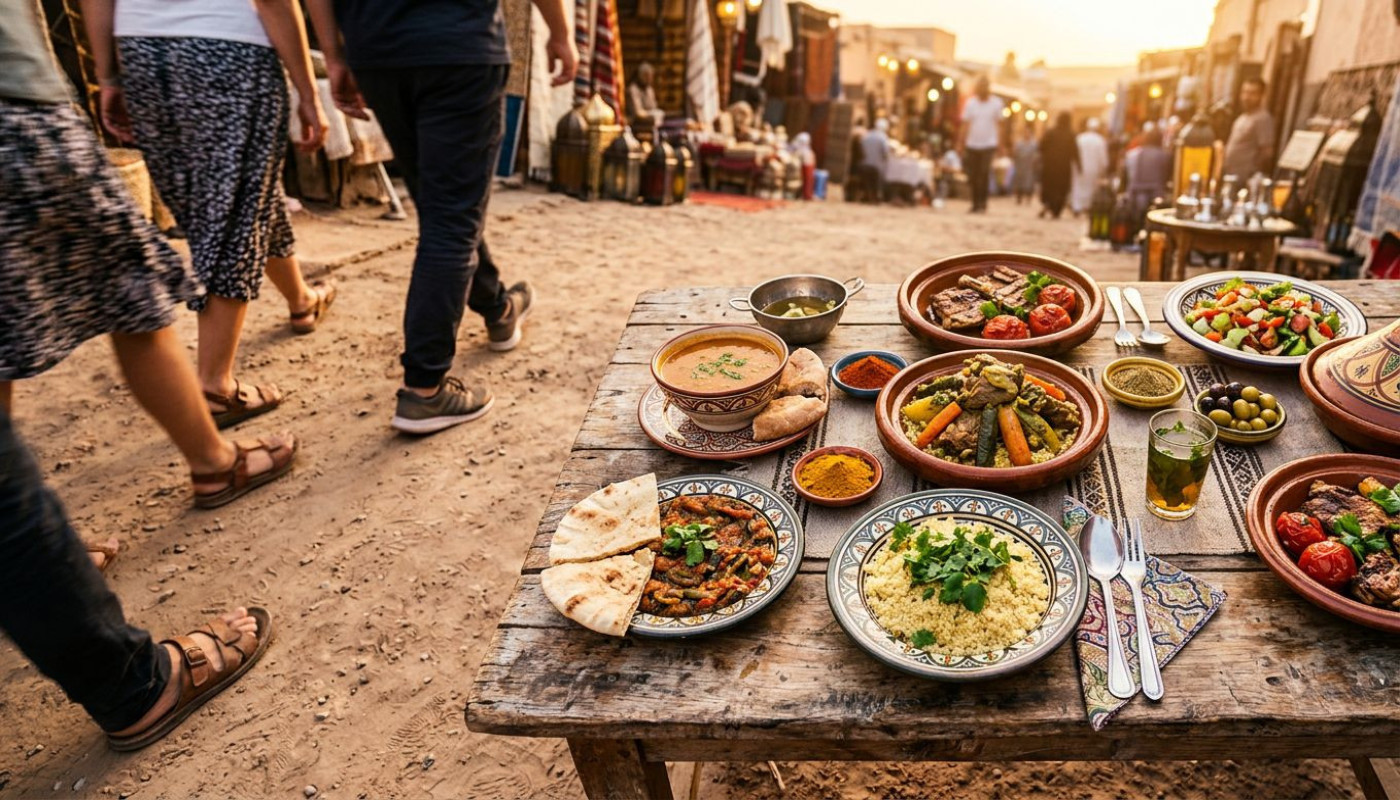
Follow the crowd, but not the obvious one. In many destinations, the true pulse is not in the main square but under a market roof, where bargaining, gossip, and quick snacks mix with shopping lists, and where visitors can read a town’s priorities in its produce. Markets compress the local food system into a walkable grid, and they offer something travelers crave: context. You learn what grows nearby, what is imported, what is cheap, what is celebratory, and what people eat on an ordinary Tuesday, and that single hour can clarify the rest of the itinerary more effectively than any brochure.
Taverns, meanwhile, act as informal travel offices. Ask what to order, and you often receive a geography lesson: the sheep graze up there, the olives come from that valley, the wine is from a family cousin, and the best view is five minutes beyond the last houses. In smaller countries and less-saturated regions, this is where a trip opens up, because locals still recommend places that are not engineered for visitors, and because the meal comes attached to directions, names, and a sense of belonging. If you are planning a route through the Balkans, for instance, and you want to connect landscapes to plates rather than to checklists, why not find out more and start building days around the people who cook them.
There is also an economic undercurrent that shapes what travelers experience. Market stalls and small restaurants are often the first to feel inflation, fuel costs, and supply shocks, and the way they adapt becomes part of the visitor’s story, with menus changing faster, portions adjusting subtly, and certain ingredients becoming occasional luxuries. For the traveler, this is not just price sensitivity; it is a reminder that “local cuisine” is not frozen in time. It is a living negotiation between tradition, purchasing power, and what the land can produce this season, and that is precisely why it can make an itinerary feel more real than a string of photogenic sites.
When a dish pulls you off route
A single specialty can become a compass. Travel agendas are increasingly shaped by “signature” foods, and not only the famous ones, because social media and review platforms have flattened the hierarchy of what counts as worth traveling for. A small town can trend for a pastry, a mountain village can draw attention for a smoky stew, and a coastline can become defined by a particular way of grilling fish, and once that happens, visitors start planning detours that would have sounded irrational a decade ago. The logic is simple: if you can eat it only there, then there is a reason to go there, and the journey itself becomes part of the value.
This is where local cuisine reshapes distances. Travelers who might have booked a single base now split nights across regions to chase variety, and they accept slower transport if it connects them to food landscapes, a winery road, a riverside grill culture, a pastoral cheese belt. That shift matters, because it redistributes spending beyond capital cities and resorts, and it can extend seasons in places that struggle with short summer peaks. In the best cases, it supports producers who keep traditional methods alive, but it can also raise uncomfortable questions about overtourism, menu standardization, and the temptation to perform “authenticity” for demand.
For travelers trying to avoid the trap of eating the same “traditional platter” everywhere, the best strategy is to look for specificity. Ask what is in season, what is cooked for family meals rather than for visitors, and what is made in-house, and then follow the answer even if it disrupts the day’s plan. Specificity is usually a sign of legitimacy, while vague, all-year, all-purpose menus can be a sign that the kitchen is feeding expectations, not local appetites. The reward is not only a better meal, but a different travel narrative, because you start remembering the trip in tastes, smells, and conversations, not only in buildings and viewpoints.
Cooking classes are changing the souvenir
The new postcard is a recipe. Travelers have long brought home magnets and bottles, but the fastest-growing “souvenir” in many destinations is knowledge: how to fold the dough, how to balance the acid, how to cook a cut that locals prize, and how to time a dish so it tastes like it did at the table. Cooking classes and food workshops turn passive consumption into participation, and they also solve a classic travel problem, because the visitor who learns the technique gains a deeper memory than the visitor who only takes a photo.
This trend fits broader tourism patterns. Experience-led travel has been rising for years, and food experiences are among the most accessible, because they cut across language barriers and work in any weather. They also create contact with people who rarely appear in conventional sightseeing, from home cooks to small-scale farmers, bakers, and foragers. In destinations where history is complex and identity is debated, the kitchen often provides a gentler entry point, because a dish can carry regional pride without demanding that a visitor understand every political layer on day one.
There is, however, a line between respectful learning and curated performance. The best workshops tend to be rooted in real kitchens, seasonal ingredients, and a frank discussion of what has changed over time, while the weakest ones chase stereotypes and serve the same narrative regardless of month or market conditions. For travelers, a few checks help: small group sizes, transparent sourcing, and a menu that reflects what is actually available locally. When it works, the class reshapes the rest of the trip, because you start noticing ingredients in markets, ordering more confidently, and choosing restaurants based on craft rather than on rankings alone, and you return home with a skill you can repeat.
Planning notes for hungry travelers
Book key tables early, and keep room for spontaneity. Build a daily budget that includes at least one paid experience, market grazing, and a few surprises; prices vary sharply by season and location. Check whether local or national programs support rural tourism, tastings, or agritourism, because some regions subsidize visits and workshops, and that can stretch a trip without lowering quality.
On the same subject


